Others vs TotsName: An Honest Kundali Report Quality Comparison
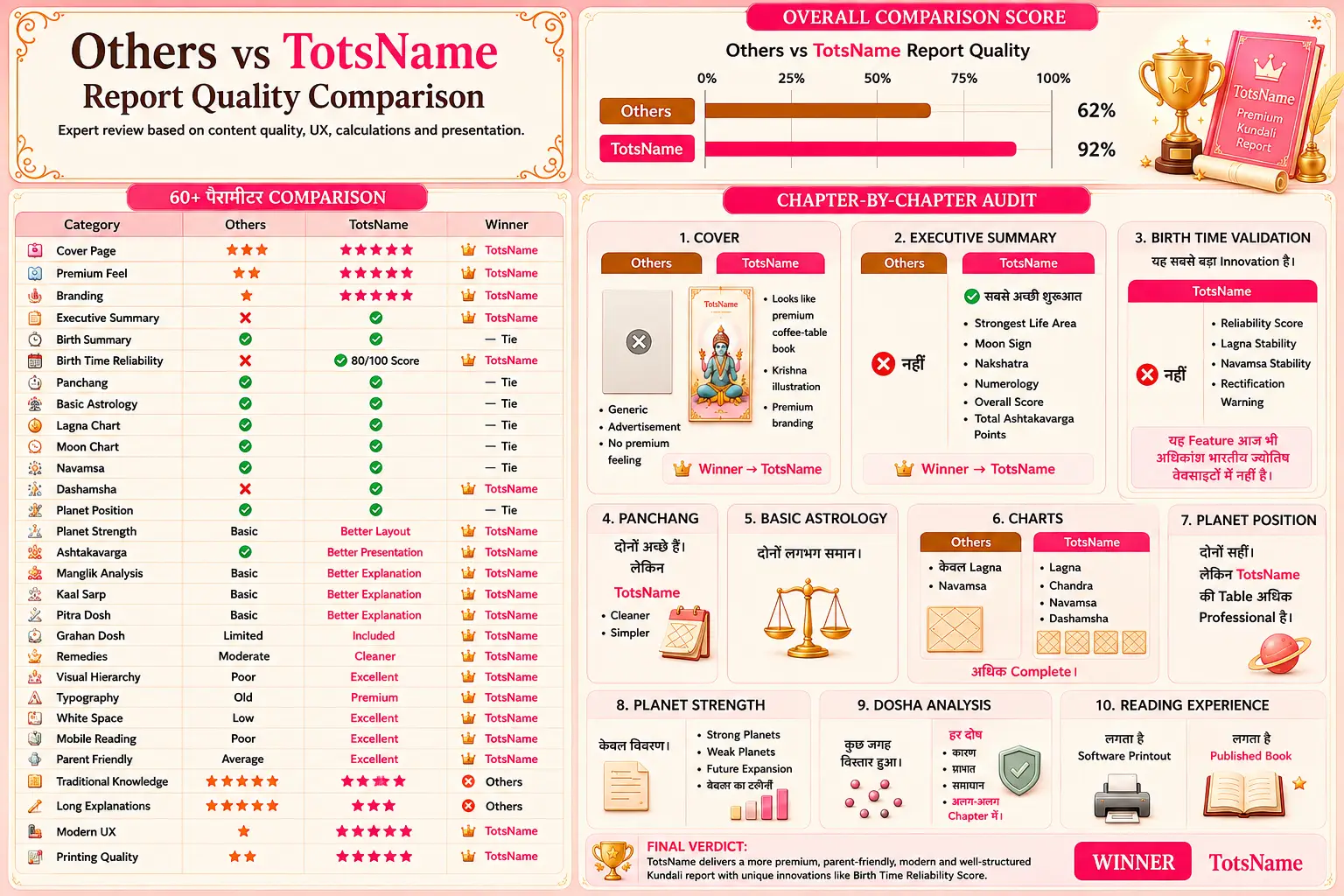
Every astrology website will tell you its report is the best one. That is easy to say and hard to check, so we did the boring thing instead: we took the reports the major Indian astrology sites generate, put them next to ours, and compared them across more than sixty parameters — content, calculations, layout, and how the thing actually reads when a tired parent opens it at midnight.
The overall result was 92% for TotsName against 62% for the others. That headline matters less than where the difference comes from, so here is the detail — including the parts where we did not win.
Where the reports are genuinely equal
It would be dishonest to claim an advantage that does not exist. On the core astrological content, the established sites are doing perfectly good work, and our audit scored these as ties:
Birth summary, Panchang, basic astrology, the Lagna chart, the Moon chart, Navamsa, and planetary positions. If all you need is a correct chart, most serious sites will give you one. The mathematics of Vedic astrology is not a secret, and the ones worth using follow the same standard.
Where TotsName is ahead
1. Birth time reliability — the one nobody else does
This is the innovation we are proudest of, and it is the clearest gap in the comparison. Almost every Indian astrology site takes the birth time you type in and treats it as gospel. But most people do not know their birth time to the minute; they know what a relative remembered, or what a hospital slip said, or a rounded figure.
That matters enormously. A few minutes of error can move the Lagna, and a moved Lagna changes the entire reading. So the TotsName report carries a Birth Time Reliability Score — an 80/100 style rating covering Lagna stability, Navamsa stability, and a rectification warning when your stated time sits close to a boundary. The others simply produce a chart and say nothing about how much you should trust it.
2. Executive summary
Our report opens with a summary: strongest life area, Moon sign, Nakshatra, numerology, overall score and total Ashtakavarga points, all on the first page. The comparison reports had no executive summary at all — you are handed forty pages and left to find the point yourself.
3. Explanation rather than labels
On Manglik analysis, Kaal Sarp, Pitra Dosh and Grahan Dosh, the other reports mostly give you a verdict: present or absent. Ours explains what the placement is, what it traditionally means, and what remedies are suggested — with dosha causes, effects and remedies each in their own chapter rather than compressed into a line.
4. Charts and depth
Where a typical report gives Lagna and Navamsa, ours adds Chandra and Dashamsha. Planet strength moves beyond a description to strong planets, weak planets and future expansion. Ashtakavarga is presented rather than merely printed.
5. How it reads
This is the part that is hard to quantify and easy to feel. The audit scored the others as poor on visual hierarchy, old on typography, low on white space, poor on mobile reading and average on parent-friendliness. Their reading experience was summed up as "looks like a software printout".
Ours was summed up as "looks like a published book" — a premium cover with Krishna illustration and branding, a cleaner Panchang, a more professional planetary table, and a layout that survives being read on a phone. For a document you may keep for your child's whole life, that is not decoration.
Where the others beat us — and why we are not rushing to fix it
Two categories in the audit went against TotsName, and both are worth stating plainly.
Traditional knowledge. The long-established sites carry more of it. Many have decades of accumulated material, and depth of that kind takes years rather than a redesign.
Long explanations. Their reports contain more text than ours. This one is a deliberate choice rather than a shortcoming: we would rather a parent read and understand twenty pages than skim eighty. But if you specifically want exhaustive commentary on every placement, you will find more of it elsewhere, and you should know that before you buy.
What this means when you are choosing
If you want a correct chart and nothing more, most reputable sites will serve you, and several are free. If you want a report that tells you how far to trust its own birth time, opens with a summary instead of a wall of tables, explains a dosha instead of naming it, and reads like something you would keep — that is the gap this comparison measures.
We have published the full chart above so you can check the claims rather than take our word for them. And if you find a category where you think we have scored ourselves too generously, write to us; we would rather correct the chart than defend it.
Frequently asked questions
How was this comparison carried out?
It is an expert review across more than sixty parameters covering content quality, user experience, calculations and presentation, plus a chapter-by-chapter audit of the generated reports. It is a considered assessment rather than a laboratory measurement, and the full chart is published above so you can judge each line yourself.
What is a Birth Time Reliability Score?
A rating of how much confidence your chart deserves given the birth time you entered. It covers Lagna stability, Navamsa stability and a rectification warning when your stated time falls near a boundary where a few minutes would change the reading. Most Indian astrology sites do not offer anything comparable.
Did the other reports beat TotsName anywhere?
Yes, in two categories: traditional knowledge and long explanations. Established sites carry more accumulated traditional material, and their reports contain more text. We chose a shorter report that a parent will actually finish, but that is a trade-off and you should know about it.
Are the astrological calculations different between sites?
Not fundamentally. The audit scored birth summary, Panchang, basic astrology, Lagna chart, Moon chart, Navamsa and planetary positions as ties. Serious sites follow the same standard astronomical method, so the difference lies in validation, presentation and explanation rather than in the mathematics.
Which ayanamsa does the TotsName report use?
Lahiri, the standard reference used by traditional Indian astrologers, so the results line up with what a family astrologer would calculate.
Related articles
Arabic Baby Names: Meanings of Light, Virtue & Grace
Global Baby Names: Beautiful Choices from Cultures Around the World
5 Mukhi Nepali Rudraksha — Benefits, Care & How to Identify (Hindi/English)
All articles
Browse every guide and story on the blog.
- 📊 Others vs TotsName: An Honest Kundali Report Quality Comparison · you're reading Astrology
- 🌙Arabic Baby Names: Meanings of Light, Virtue & Grace Baby Names
- 🌍Global Baby Names: Beautiful Choices from Cultures Around the World Baby Names
- 📿5 Mukhi Nepali Rudraksha — Benefits, Care & How to Identify (Hindi/English) Rudraksha
- 🕉️Rudraksha: 15 Important Insights into Energy, Spiritual Practice & Consciousness Rudraksha
- 🌱Child Growth & Development: The Complete Milestone Guide (Birth to 5 Years) Child Development
- 🍼Baby Care: The Complete Guide from Birth to 12 Months Baby Care
- 🤰Pregnancy: The Complete Week-by-Week Guide for Expecting Parents Pregnancy
- 💉Vaccination Guide: Complete Immunization Schedule & FAQs Health
- 🧸Parenting Tips: Raising Happy, Healthy & Confident Children Parenting
- 🍼Baby Feeding Guide: Breastfeeding, Formula & Solid Foods Feeding
- 👶Newborn Care: The Essential Guide for First-Time Parents Newborn Care
- 🥗Building Healthy Eating Habits in Children (A Gentle Guide) Kids' Health
- 😴Why Sleep Matters: A Parent's Guide to Children's Sleep Kids' Health
- 🧐7 Baby Name Mistakes to Avoid (From Parents Who've Been There) Naming Tips
- 🛡️Strengthening Your Child's Immunity — What Actually Works Kids' Health
- 🔯Why a Name Carries So Much Meaning in Indian Culture Culture
- 🌍Sacred Life Ceremonies Across the World's Major Religions Culture & Traditions
- 🏃Active Bodies, Healthy Kids: Movement and Screen-Time Balance Kids' Health
- 🌸Beautiful Baby Names Starting With A and B (With Meanings) Baby Names
- 💛Your Child's Emotional Wellbeing: The Health That's Easy to Miss Kids' Health
- 💝How to Choose a Baby Name That Carries Meaning Naming Tips
- 🌼Beautiful Baby Names Starting With C and D (With Meanings) Baby Names
- 🌙Naming Your Baby by Rashi and Nakshatra: A Simple Guide Astrology
- 🌸Beautiful Baby Names Starting With E and F (With Meanings) Baby Names
- 🌷Beautiful Baby Names Starting With G and H (With Meanings) Baby Names
- 🌸Modern Sanskrit Baby Names That Feel Fresh in 2026 Baby Names
- 🌻Beautiful Baby Names Starting With I and J (With Meanings) Baby Names
- 💐Beautiful Baby Names Starting With K and L (With Meanings) Baby Names
- 🌺Beautiful Baby Names Starting With M and N (With Meanings) Baby Names
- 🍃Beautiful Baby Names Starting With O and P (With Meanings) Baby Names
- ✦Beautiful Baby Names Starting With Q and R (With Meanings) Baby Names
- 🌟Beautiful Baby Names Starting With S and T (With Meanings) Baby Names
- 🌈Beautiful Baby Names Starting With U and V (With Meanings) Baby Names
- 🐣Beautiful Baby Names Starting With W–Z (With Meanings) Baby Names
- 🐾200 Cutest Pet Names for Dogs and Cats in India Pet Names
- 📖The Mythological Stories Behind Popular Hindu Names Name Stories
- ☬Most Beautiful Sikh Baby Names with Meanings Sikh Names
- 🕉️Top 100 Hindu Baby Girl Names for 2026 — Meanings, Roots & How to Choose Hindu Names
- ☪️Muslim Names That Mean Light & Blessing — A Gentle Guide Muslim Names
- ⭐50 Unique Baby Names That Will Stand Out (Without Being Hard to Live With) Trending 2026